OYSTER — CASE STUDY
Editoral Content
Collection
PROJECT SNAPSHOT
ROLE
Brand Design Lead
TIMELINE
May - October 2024, three flagship releases
FOCUS
Editorial art direction, design-system development, project scoping and production, external partner direction, digital campaign design, QA
TEAM PARTNERS
Brand, Content Marketing, Growth and Demand Generation, Web and Lifecycle, Legal, external illustration and production partners
TOOLS
Figma, Adobe Creative Suite, Asana, Notion, Google Docs, Loom
DELIVERABLES
Report visual systems, editorial layouts, illustration direction, landing page and form assets, social/email/blog toolkits, reusable templates and documentation
BROADER IMPACT
Three coordinated report launches
Repeatable end-to-end workflow
Cross-functional partner adoption
Approx. $300K avg influenced/sourced closed-won revenue, contributed through design support
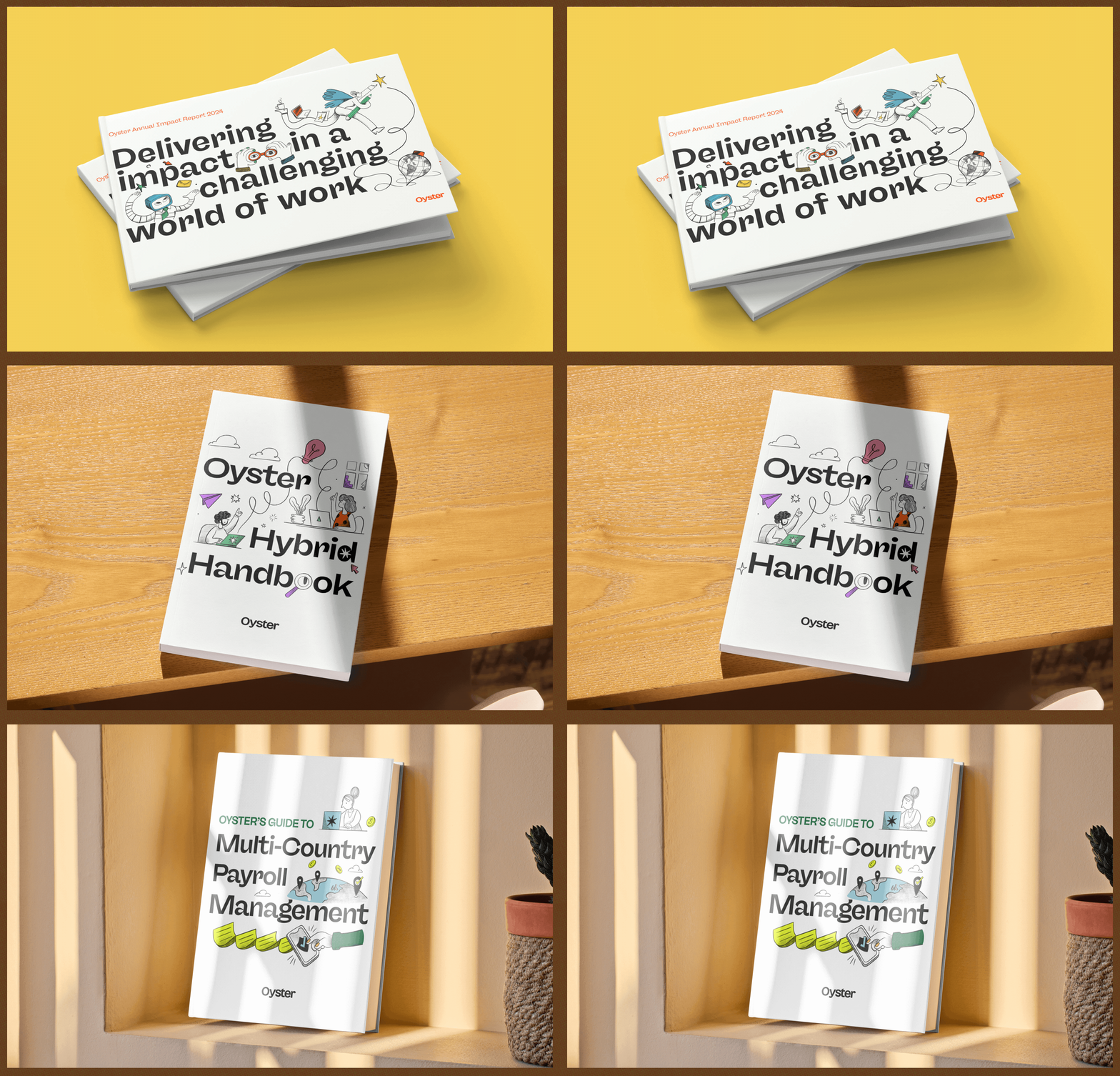
Building a scalable system for flagship reports and their digital launches
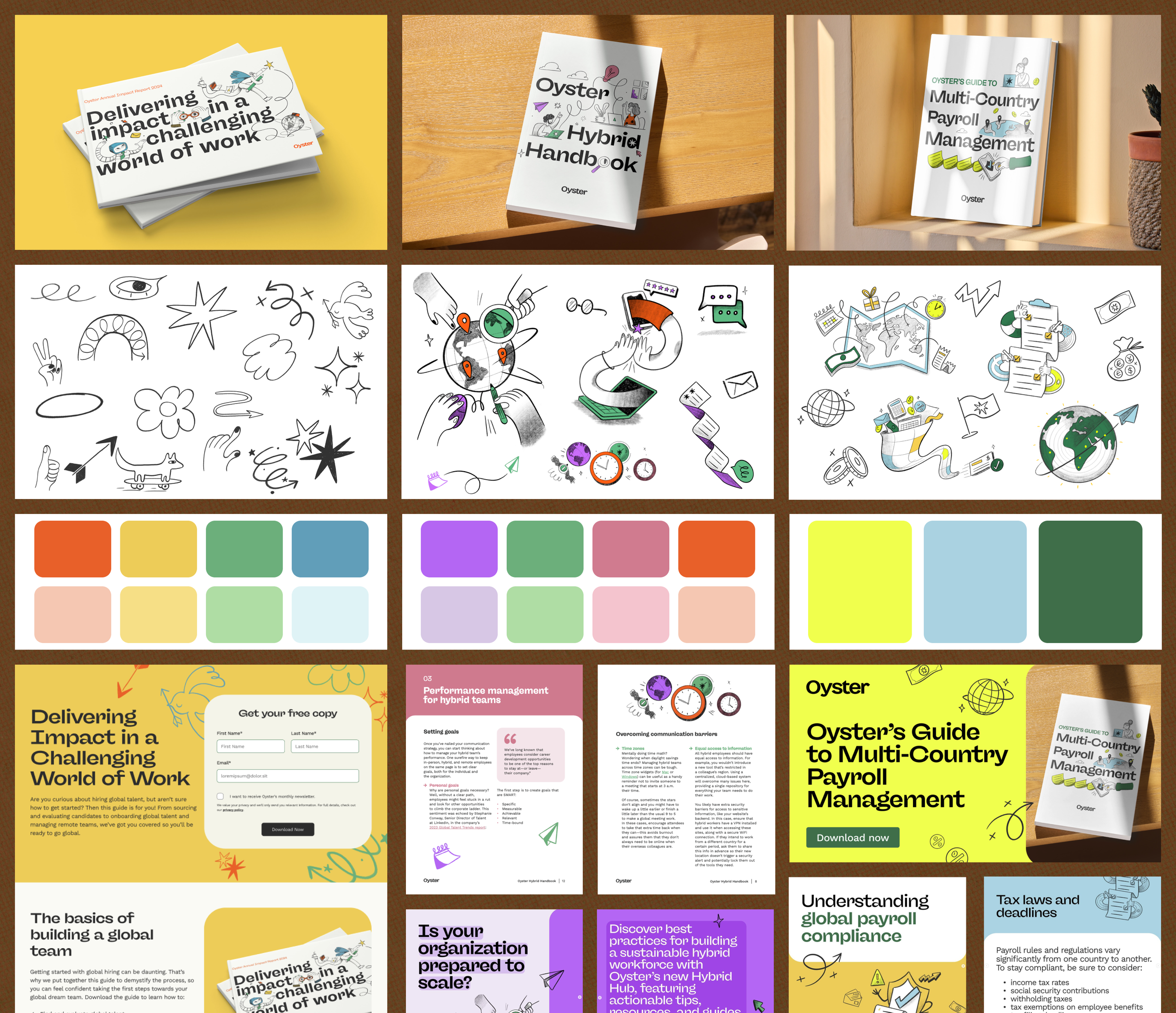
In 2024, Oyster expanded its editorial strategy through three flagship gated-content launches: the Annual Impact Report, Hybrid Handbook, and Guide to Multi-Country Payroll Management.
As Brand Design Lead, I created a repeatable system for art direction, production, partner collaboration, and multi-channel rollout. The collection balanced a recognizable Oyster foundation with enough flexibility for each report to tell a distinct story.
DESIGN CHALLENGE
Three distinct stories, one recognizable family
Each report had its own subject, campaign goal, and creative opportunity:
The Impact Report needed to communicate progress and accountability.
The Hybrid Handbook called for a more expressive and people-centered tone.
The Guide to Multi-Country Payroll Management needed to make a technical topic feel clear, practical, and approachable.
The challenge was to create enough consistency for the reports to feel related without forcing them into one formula. I divided the system into fixed and flexible layers.
Core typography, logo use, accessibility, layout discipline, and brand principles remained stable. Accent palettes, illustration motifs, cover composition, and campaign modules could change to support the story of each publication. This created a recognizable collection while preserving a distinct point of view for every launch.
CONTEXT
Flagship content was becoming a recurring growth channel
As Oyster’s content strategy matured, long-form reports became an increasingly important way to educate customers, build authority in a complex category, and support demand generation.
In 2024, the team planned three major launches across a five-month period: the Annual Impact Report, Hybrid Handbook, and Guide to Multi-Country Payroll Management. Each publication addressed a different business problem and audience, but all three needed to reinforce Oyster as a credible, useful resource for distributed companies.
Rather than treat the work as three disconnected design projects, I saw an opportunity to create a shared editorial framework and repeatable production model that could improve quality, visibility, and speed with every launch.
BUILDING THE WORKFLOW
The production model improved with every launch
A repeatable visual system alone would not solve the operational complexity. Each launch depended on content finalization, legal review, creative development, illustration, layout production, and coordinated promotion across several teams.
I built a phased workflow that gave partners visibility from kickoff through launch: strategic editorial planning, content and legal readiness, moodboarding and creative briefing, illustration and layout production, then digital asset creation.
Clear scopes, working timelines, decision owners, and review checkpoints reduced late-stage surprises. I used each launch to refine the process, making the next project easier to estimate, brief, review, and deliver. When external partners supported illustration or layout, I provided focused creative direction and consolidated feedback against the same system.
SCALING ACROSS DIGITAL CHANNELS
The PDF was one part of a larger campaign system
Each publication extended into a coordinated digital launch across landing pages, forms, social, email, blog, content, and supporting campaign assets.
I translated the visual language of each report into reusable digital modules rather than recreating every placement from scratch. Shared layout patterns, adaptable illustration groupings, and structured Figma files helped the team produce channel-specific assets while preserving a consistent customer journey from first impression through download.
For partner-led production, I created templates and examples, walked teams through how to use them, and completed final design reviews before handoff or launch. This allowed content and marketing partners to move with greater independence while keeping work aligned with the brand.
IMPACT & REFLECTION
Editorial design became repeatable business infrastructure
The collection created a more coherent customer experience across three high-value content launches and strengthened collaboration between Brand Design, Content, Growth, Web, Lifecycle, Legal, and external creative partners.
Internal reporting attributed meaningful pipeline and closed-won influence to the gated assets. Design work on the content campaigns influenced five and six figure ARR (annual recurring revenue) pipeline closed/won.
The longer-term value was the framework itself. Shared visual rules, clearer scopes, repeatable templates, and a visible production process made future editorial work easier to plan and scale. The project reinforced that good systems do not flatten creativity. The right constraints create room for each story to feel specific while still belonging to a larger brand.
✽ JUMP TO ✽